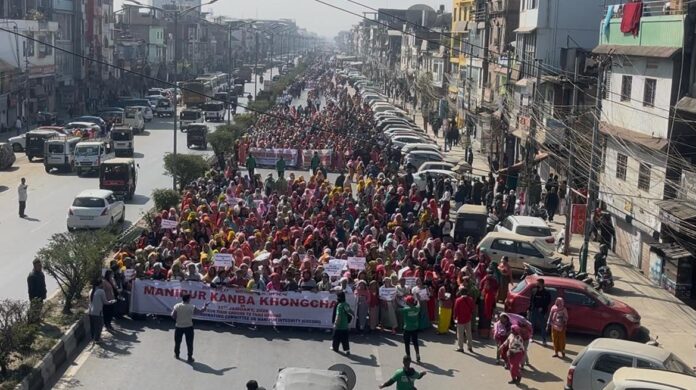

Imphal: Since May 3, 2023, Manipur has entered a deeply troubling phase of armed communal disturbances, marked by the outbreak of violence, retaliatory actions, and a continuing cycle of confrontations between Kuki and Meitei groups. As the disturbances have persisted, hundreds have lost their lives, thousands have been injured, and nearly one lakh people have been displaced. Homes and properties have been destroyed, freedom of movement has been severely restricted, and the broader economy and livelihoods across the state have been gravely disrupted.
In the course of the violence, widespread propaganda has shaped and circulated misleading interpretations of both the causes of the disturbances and their consequences. The initial outbreak has often been narrowly portrayed as a unified tribal response to the Meitei demand for Scheduled Tribe status, particularly in light of the recommendation made by the Manipur High Court to consider the matter.
Such narratives have reduced a complex and layered conflict into overly simplistic binaries—tribal versus non-tribal (Meitei), majority (Meitei) versus minority (tribal), hill (tribal) versus valley (Meitei), or Hindu (Meitei) versus Christian (tribal). These reductive framings obscure the deeper structural tensions, historical grievances, and political complexities that underpin the disturbances, thereby distorting public understanding of the actors involved, as well as the context and nature of the conflict.
At the same time, one-sided representations have portrayed the government led by the Bharatiya Janata Party in Manipur as primarily advancing Meitei interests at the expense of Kuki communities, while also casting the Meitei population in an aggressive and villainous light. Such portrayals obscure important realities, including the significant representation of BJP MLAs within the ruling establishment, the failure of the regime to adequately address the concerns of Meitei victims, and the alleged roles of Indian security forces in collusion with Kuki armed groups.
The disturbances must be understood within a broader structural context shaped by a long-evolving economic, political, and social trajectory. This trajectory, often associated with a neo-liberal policy framework, has been marked by uneven development, persistent underdevelopment, corruption, political manipulation, illicit economic networks, demographic pressures, ecological strain, and patterns of marginalisation and deprivation.
As these structural pressures have generated both democratic mobilisations and insurgent movements over time, the response of the Government has failed to invest in durable and inclusive solutions. Instead, a divisive approach has been adopted, in which reactionary forces have been instrumentalised to deepen communal divides and suppress broader popular movements seeking democracy and equitable development.
Communal forces operating in alignment with such regimes, including those linked to Suspension of Operations (SoO) arrangements and their proxies, have mobilised and misdirected vulnerable populations, contributing to the escalation of communal violence. At the same time, the Government’s failure to adequately protect lives, property, and livelihoods has deepened insecurity, forcing communities to organise for self-defence and, at times, retaliation—further intensifying the cycle of violence and mistrust. Despite heavy militarisation, changes in local leadership, and even the imposition of President’s Rule, armed violence has not been effectively contained and continues to persist in various forms.
Sincere peace efforts on the part of the Government have been lacking. In recent months, there has been an increase in intra- and inter-tribal tensions and violence, including within and among Kuki–Chin–Zo groups, between Kuki and Tangkhul groups, and tensions between Kuki groups and Mao, Poumai, and others. These developments point to an increasingly complex and deteriorating security situation despite heavy militarisation, with the role of communal armed proxies becoming increasingly dominant.
On this occasion, marking the anniversary of the events of May 3, 2023, the Meitei Alliance reiterates its position that the territorial integrity of Manipur, along with the unity of its people, peace, and development, must not be compromised. It calls for stronger regulation of demographic influx, as well as strict action against narcotics-related activities and illegal poppy cultivation. The Alliance also appeals for the protection of the environment, forests, and a sustainable ecosystem.
At the same time, the Meitei Alliance holds the Government accountable for multiple failures, including its inability to restore peace and public order, to provide adequate security for life, property, and livelihoods, and to effectively address restrictions and disruptions along national and state highways. The Alliance also criticises the continued enforcement of divisive “buffer zones” within the state. The failure to address the humanitarian concerns of internally displaced persons (IDPs), and to ensure conditions for their safe return to their original settlements, reflects a broader indifference towards both the affected populations and the peace process.
The Alliance calls upon the people of Manipur, across all communities, to recognise the gravity of the situation affecting all, to remain united, and to hold the Government accountable—in both spirit and action—for the restoration of peace and the strengthening of democracy.