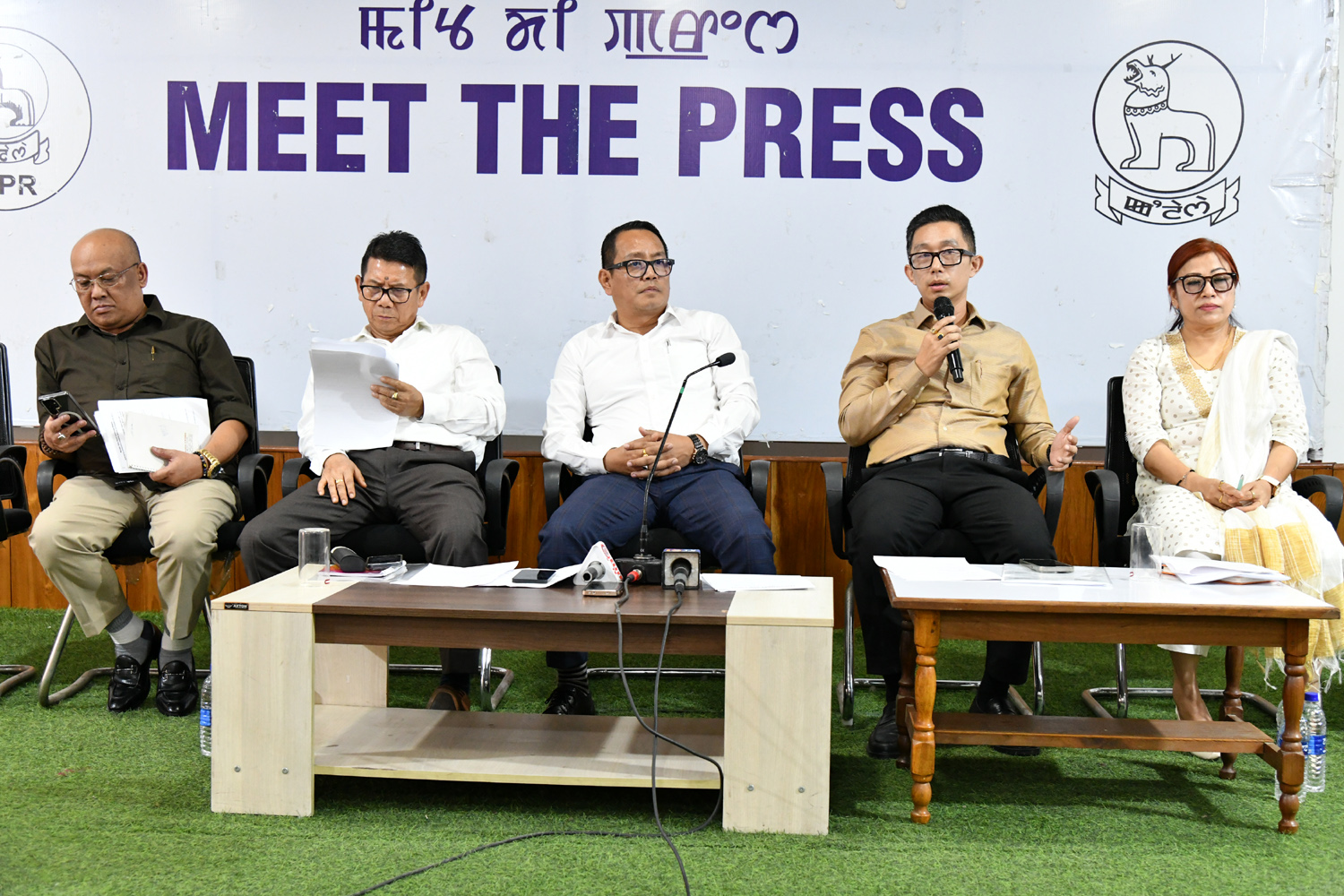

Imphal: The Directorate of Information and Public Relations (DIPR), Government of Manipur, organised the sixth session of its “Meet the Press” series today at the DIPR Auditorium, Nityaipat Chuthek, Imphal. The session featured officials of the Department of Rural Development & Panchayati Raj (RD&PR), Government of Manipur, who highlighted the Department’s major infrastructure development projects and flagship schemes being implemented across the State.
The session was attended by Ksh. Umananda Singh, Director, RD≺ Kh. Temba Singh, Chief Engineer, Rural Engineering Department, RD≺ Lanjoy Thoudam, Joint Secretary, RD≺ G. Kavita, State Mission Manager, Manipur State Rural Livelihoods Mission (MSRLM) and Kh. Bobby, Chief Operating Officer (Skills), MSRLM.
Addressing media persons, Director Ksh. Umananda Singh said that one of the Department’s primary responsibilities is strengthening the capacities of elected Panchayati Raj Institution (PRI) representatives and Panchayat functionaries through training programmes, workshops, seminars and the preparation of training modules. These initiatives are carried out in accordance with the guidelines of the Government of India and the Ministry of Panchayati Raj to enable PRI members to effectively discharge their responsibilities.
He informed that training programmes cover important areas such as the conduct of Gram Sabhas, preparation of Gram Panchayat Development Plans (GPDP), Panchayat Advancement Index (PAI), and other performance indicators. The Department also coordinates with government line departments to facilitate planning and implementation at the Gram Panchayat level while assisting Panchayats in preparing development plans, uploading data and implementing various schemes.
During the financial year 2025–26, Umananda said that around 350 training programmes were conducted with the participation of 14,440 trainees at an expenditure of approximately ₹2.8 crore through the State Institute of Rural Development (SIRD), the State’s premier training institution for Panchayati Raj Institutions. Officials also participated in workshops and training programmes outside the State. For the financial year 2026–27, a proposal of around ₹1 crore has been submitted and is under approval, he added
The Director further stated that the Department is intensifying efforts to improve the State’s performance under the Rashtriya Gram Panchayat Advancement Index while enhancing the own-source revenue generation capacity of Gram Panchayats through capacity-building initiatives. Special emphasis is also being given to strengthening the role of women representatives in Panchayat governance.
He added during 2025–26, the State received a recurring grant of about ₹66.80 lakh, under which 81 training programmes benefiting 2,465 participants were organised. An Extension Training Centre has also been established at Lamphel to further strengthen training infrastructure.
Regarding the State Finance Commission and the 16th Finance Commission grants, the Director explained that funds have remained withheld since 2022 due to the non-conduct of Panchayat elections. He informed that proposals and activity plans have already been submitted to the Finance Department, while Administrative Committees are currently functioning at the district and Gram Panchayat levels until elected bodies are constituted.
Speaking on the Department’s flagship rural employment and housing schemes, Joint Secretary Lanjoy Thoudam highlighted the implementation of the VB-G RAM G (Viksit Bharat – Guarantee for Rozgar and Ajeevika Mission–Gramin) and Pradhan Mantri Awaas Yojana–Gramin (PMAY-G).
He stated that with effect from July 1, 2026, VB-G RAM G has replaced MGNREGS in Manipur, guaranteeing up to 125 days of wage employment to eligible rural households while promoting durable community assets, natural resource management, climate resilience and livelihood enhancement.
He informed that during the financial year 2026–27, the scheme has registered 7.02 lakh active workers and provided employment to 4.73 lakh households. A total of 91.54 lakh person-days of employment has been generated, while wages amounting to ₹242.88 crore have been directly transferred to beneficiaries through Direct Benefit Transfer (DBT). Besides, 5,850 community assets related to water conservation, irrigation, rural connectivity and natural resource management have either been completed or are under execution. He also stated that all ongoing MGNREGS works have been successfully transitioned into the new framework through awareness programmes, IEC activities and capacity-building initiatives.
On PMAY-G, Lanjoy Thoudam stated that the scheme continues to provide financial assistance for the construction of safe, durable and disaster-resilient houses with basic amenities. So far, 1,01,549 houses have been sanctioned, of which 30,469 have been completed and 71,080 are under construction. Financial assistance amounting to ₹873.37 crore has been transferred directly to beneficiaries through DBT.
He further informed that the Awaas+ Survey has been completed to identify left-out eligible beneficiaries, paving the way for the construction of an additional 1.8 lakh houses under PMAY-G. He also mentioned that the Government of India has approved 12,000 PMAY-G houses for the rehabilitation of Internally Displaced Persons (IDPs) in Manipur.
State Mission Manager, MSRLM, G. Kavita highlighted the achievements of the Manipur State Rural Livelihoods Mission in empowering rural women through community institutions and sustainable livelihood opportunities.
She informed that the Mission has formed 13,829 Self-Help Groups (SHGs), mobilising 1,38,769 rural women across the State. In addition, 1,119 Village Organisations and 23 Cluster Level Federations have been established to strengthen grassroots institutions.
She stated that the Mission has facilitated bank credit worth ₹181.1 crore for SHG members and supported nearly 24,000 women entrepreneurs under the Lakhpati Didi initiative. Furthermore, 38,761 rural enterprises have been promoted in agriculture, handicrafts, food processing and allied sectors, generating sustainable livelihoods and employment. She reaffirmed the Mission’s commitment to strengthening financial inclusion, entrepreneurship, market linkages and livelihood opportunities for rural women.
Chief Operating Officer (Skills), MSRLM, Kh. Bobby highlighted the achievements of the Deen Dayal Upadhyaya Grameen Kaushalya Yojana (DDU-GKY), the flagship placement-linked skill development programme under the Ministry of Rural Development.
He said the programme aims to transform rural youth into a skilled and employable workforce through quality training, industry-recognised certification and sustainable employment opportunities.
He informed that the programme has achieved a training completion rate of over 90 per cent and a placement rate exceeding 67 per cent. So far, 56 candidates have secured overseas employment, including placements in the UAE, USA, Oman, Maldives, the United Kingdom, Croatia, Portugal, Kuwait, New Zealand and Japan, with reputed organisations such as Air India, IndiGo, Air Serbia, Hyatt Regency Tokyo and Park Hyatt Abu Dhabi.
He further stated that since its inception, DDU-GKY has trained 8,860 rural youth across sectors including Tourism and Hospitality, Healthcare, Aerospace and Aviation, IT-ITeS, Electrical, Retail, Beauty and Wellness, Apparel, Fashion Design and Logistics.
Bobby also highlighted the implementation of DDU-GKY 2.0 under the Action Plan 2025–2028, under which 5,410 candidates will be trained through 25 qualified Project Implementing Agencies. Training is scheduled to commence in October 2026 and conclude by December 2027, while placement and self-employment opportunities will be ensured by March 2028. He added that at least 20 per cent of the target will be covered under the Captive Employment category to ensure assured employment after training.
Chief Engineer, Rural Engineering Department, Kh. Temba Singh highlighted the achievements of the Pradhan Mantri Gram Sadak Yojana (PMGSY) being implemented through the Manipur State Rural Roads Development Agency (MSRRDA).
He stated that PMGSY has significantly improved rural connectivity by providing all-weather roads linking rural habitations to education, healthcare, markets and essential public services. Under the programme, 6,701 kilometres of all-weather roads and 4,211 kilometres of Stage-I formation cutting have been completed, connecting 622 rural habitations. Additionally, 168 bridges have been constructed, while 1,781 road projects have been completed under PMGSY Phases I, II and III.
He also highlighted the implementation of the Rashtriya Gram Swaraj Abhiyan (RGSA) and e-Gram Swaraj initiatives aimed at strengthening Panchayati Raj Institutions and promoting transparent digital governance.
Temba Singh reaffirmed the Department’s commitment to achieving sustainable and inclusive rural development through effective implementation of flagship schemes, convergence among departments, community participation and transparent governance to build resilient villages, strengthen rural infrastructure, improve livelihoods and enhance the quality of life of rural households across Manipur.
The session concluded with an interactive question-and-answer session between the officials and media persons.