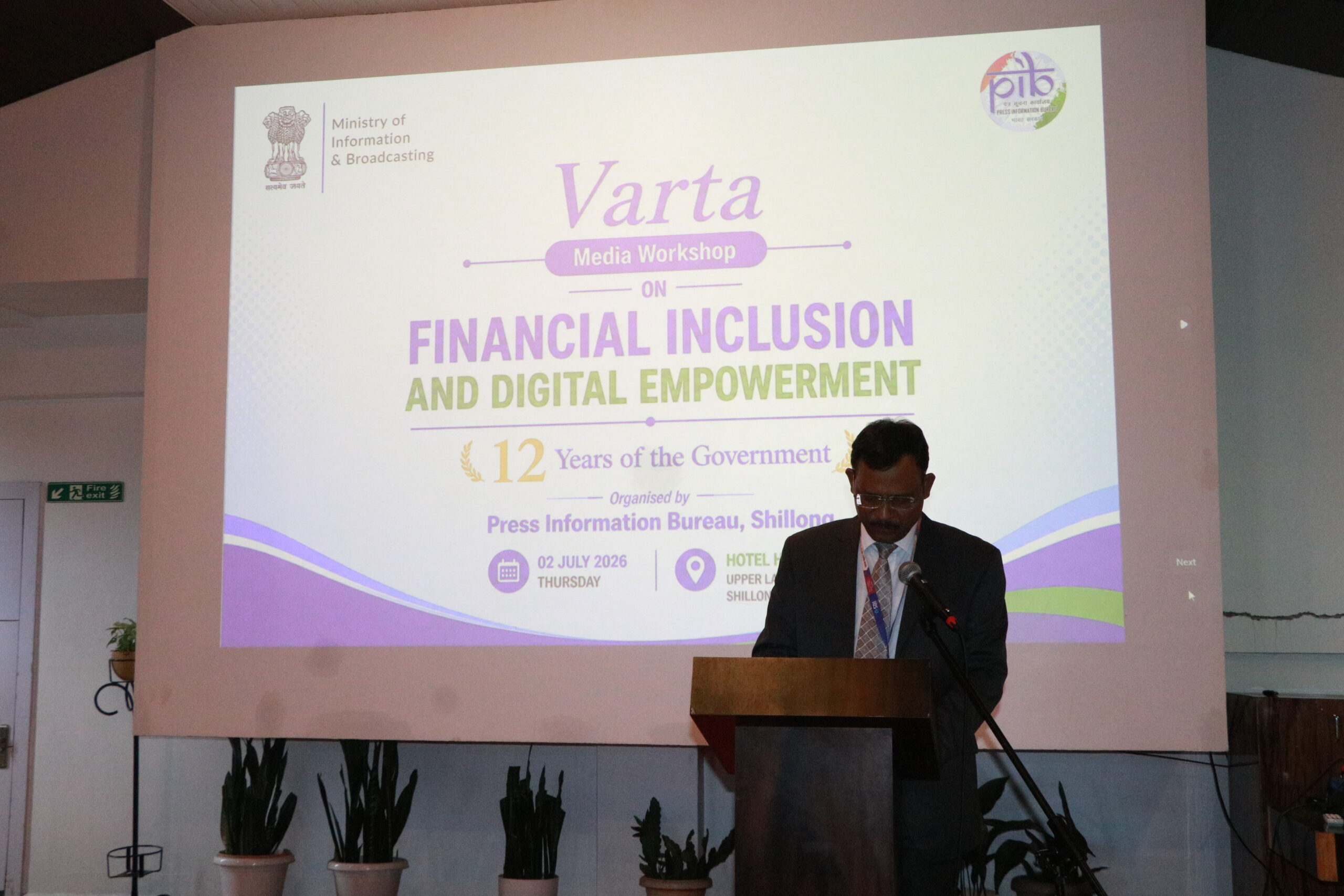

Shillong: Highlighting the remarkable progress made in financial inclusion and digital empowerment over the past twelve years, the Press Information Bureau (PIB), Shillong, under the Ministry of Information & Broadcasting, organised a Varta – Media Workshop on “Financial Inclusion & Digital Empowerment – 12 Years of the Government” in Shillong today. Bringing together senior officials from the Reserve Bank of India (RBI), State Bank of India (SBI), academia, the media and other stakeholders, the workshop showcased how policy reforms, digital innovation and collaborative efforts have transformed India’s financial ecosystem while outlining the roadmap for the next phase of inclusive growth.
Complementing the programme, the North Eastern Institute of Ayurveda & Homoeopathy (NEIAH), Shillong, organised a Medical Camp exclusively for journalists, offering free medical consultations, health screening, medicines and preventive healthcare counselling.
Welcoming the participants, Gopajit Das, Assistant Director, PIB Shillong, emphasised the media’s pivotal role in taking authentic information on financial inclusion, digital banking and cybersecurity to the grassroots, enabling citizens to make informed financial decisions. He said the workshop aimed to provide journalists with deeper insights into the Government’s flagship initiatives so that accurate and meaningful information reaches every section of society.
Delivering the inaugural address, Olden Nongpluh, General Manager (Officer-in-Charge), RBI Shillong, said the last twelve years have witnessed a paradigm shift in financial inclusion through the Jan Dhan-Aadhaar-Mobile (JAM) Trinity, Direct Benefit Transfer (DBT) and Digital Public Infrastructure, which have expanded banking access, improved transparency and accelerated digital adoption across the country. Referring to the updated National Strategy for Financial Inclusion (NSFI), he said its five pillars – equitable access to affordable financial services, gender-sensitive inclusion, livelihood integration, financial education and stronger customer protection – provide the roadmap for achieving inclusive and sustainable financial growth through coordinated efforts of governments, regulators, banks and other stakeholders. He also informed that 98 per cent of account holders in Meghalaya have adopted at least one digital mode of transaction, with efforts underway to achieve universal and meaningful digital adoption.
Highlighting Meghalaya’s achievements, Ejaz Ahmad, Deputy General Manager, State Bank of India, Shillong, said the Government’s vision of making banking accessible, affordable and technology-driven has delivered tangible outcomes across the State. Meghalaya today has 9.99 lakh Pradhan Mantri Jan Dhan Yojana (PMJDY) accounts, equivalent to 42,152 accounts per lakh adult population, with SBI alone accounting for 3.55 lakh accounts, representing 36 per cent of the total PMJDY accounts in the State.
He further informed that enrolment under the Government’s flagship social security schemes has expanded significantly, with 5.08 lakh beneficiaries under Pradhan Mantri Jeevan Jyoti Bima Yojana (PMJJBY), 9.36 lakh under Pradhan Mantri Suraksha Bima Yojana (PMSBY) and 1.02 lakh under Atal Pension Yojana (APY) in Meghalaya. SBI continues to be the largest contributor, accounting for 32 per cent, 49 per cent and 50 per cent of enrolments under these schemes respectively.
Speaking on India’s digital transformation, Ahmad said the country recorded 21,860 crore digital transactions during FY 2025–26, emerging as the global leader in digital payments, while Meghalaya alone registered 32.76 crore digital transactions during the same period. He noted that Direct Benefit Transfer (DBT) and Aadhaar-based authentication have transformed welfare delivery by ensuring benefits reach genuine beneficiaries directly, eliminating leakages, curbing corruption and strengthening public trust.
Presenting SBI’s financial inclusion initiatives, H. Khongsai, Chief Manager (Financial Inclusion), SBI Shillong, highlighted the Bank’s extensive presence in Meghalaya with 113 branches, nearly 300 Customer Service Points (CSPs) and a robust alternate delivery network serving even the remotest areas. He informed that the people of Meghalaya have entrusted SBI with deposits amounting to ₹18,551 crore, while the Bank maintains a healthy Credit-Deposit Ratio of 52 per cent, reflecting its continued commitment to financing agriculture, MSMEs and entrepreneurship.
He further highlighted that over 98 per cent of SBI customers have migrated to digital and alternate banking channels, driven by platforms such as YONO, UPI, BHIM, RuPay Cards, Aadhaar Enabled Payment Systems (AePS) and paperless account opening. He also noted that 15 Centres for Financial Literacy across Meghalaya regularly conduct awareness programmes in collaboration with NGOs to promote responsible banking, digital literacy and safe financial practices.
Delivering a presentation on RBI’s financial literacy and consumer protection initiatives, Pankaj Kumar, Manager, RBI Shillong, highlighted the Reserve Bank’s sustained efforts through Financial Literacy Week, Centres for Financial Literacy (CFLs), the Unified Programme for Financial Literacy Transmission (UPLIFT) and Electronic Banking Awareness and Training (e-BAAT). He informed that 16 Centres for Financial Literacy are functioning across all 55 Community Development Blocks in Meghalaya, reaching over seven lakh participants in 6,169 villages through awareness programmes on digital payments, social security schemes, grievance redressal and responsible financial practices. He also highlighted initiatives such as Digital Payments Awareness Week, the BE(A)AWARE magazine and the “RBI Kehta Hai” campaign, while explaining security measures including card tokenisation, multi-factor authentication, e-mandates and transaction alerts that have strengthened the safety of digital transactions.
A major highlight of the programme was the panel discussion moderated by Ms Ibankyntiew Mawrie, featuring Patricia Mukhim, Editor, The Shillong Times; Dr. Neelam Rani, Associate Professor, IIM Shillong; Hangsha Dhar Daimari, Deputy General Manager, RBI Shillong; and Shemphang Lyndoh, Chief Manager, State Level Bankers’ Committee (SLBC), Meghalaya.
The panellists unanimously acknowledged the significant progress made over the past twelve years in financial inclusion, financial literacy and digital empowerment, driven by landmark initiatives such as the JAM Trinity, Direct Benefit Transfer, digital payment platforms and social security schemes. They observed that while access to formal banking services has expanded significantly, the next phase must focus on improving financial capability, encouraging meaningful usage of financial services and strengthening cyber resilience.
Patricia Mukhim stressed that financial literacy must move beyond urban centres and reach rural Meghalaya through sustained community engagement, communication in local languages and financial education beginning at the school level.
Dr. Neelam Rani observed that although banking access has improved substantially, the focus must now shift towards improving usage, addressing gender disparities and strengthening digital capability so that financial inclusion translates into meaningful economic empowerment.
Hangsha Dhar Daimari emphasised that awareness remains the strongest defence against cyber fraud and called for greater collaboration among regulators, banks, government agencies and communities to strengthen last-mile financial inclusion.
Shemphang Lyndoh highlighted the need to further strengthen the Business Correspondent network, Customer Service Points and financial literacy initiatives so that digital onboarding translates into regular, confident and responsible use of banking services.
The Medical Camp organised by NEIAH, Shillong witnessed enthusiastic participation from journalists and complemented the workshop’s broader objective of promoting citizen welfare and holistic well-being.
The programme concluded with an interactive session where media professionals engaged with the speakers on financial inclusion, digital banking, cyber fraud prevention and last-mile banking connectivity.