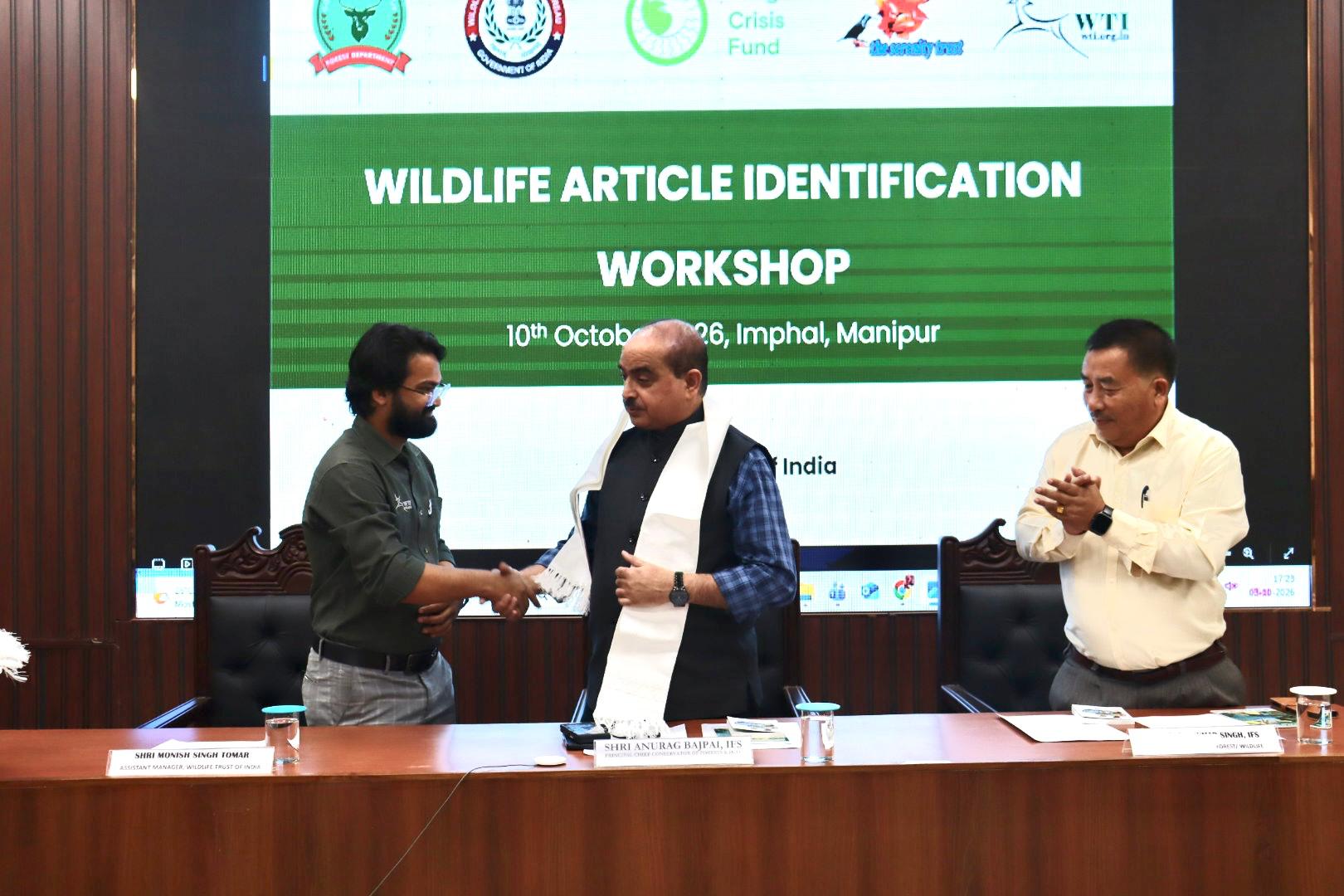

Imphal: A total of 51 enforcement officials from various departments participated in a one-day workshop on Wildlife Article Identification held at the Forest Headquarters, Sanjenthong, Imphal, on Saturday. The workshop aimed to strengthen the capacity of enforcement personnel to identify commonly traded wildlife and wildlife articles and improve the detection and prevention of illegal wildlife trade.
The workshop was organised by the Wildlife Trust of India (WTI) in collaboration with the Department of Environment, Forest and Climate Change, Government of Manipur, and the Wildlife Crime Control Bureau (WCCB), with support from the Wildlife Conservation Network’s Pangolin Crisis Fund and The Serenity Trust.
The workshop was inaugurated by Anurag Bajpai, IFS, Principal Chief Conservator of Forests and Head of Forest Force (PCCF & HoFF), Manipur, as Guest of Honour, and L. Joykumar, IFS, Chief Conservator of Forests (Wildlife), Manipur, as Chief Guest.
Participants represented the Forest and Police Departments, Airport Authority, IndiGo and Air India Express, Customs, Border Security Force (BSF), Central Industrial Security Force (CISF), State Intelligence Bureau (SIB), and Excise Department, providing a platform for strengthening coordination among agencies involved in preventing wildlife trafficking.
The technical sessions were delivered by Monesh Singh Tomar, Assistant Manager, Wildlife Trust of India, who provided an overview of wildlife crime, illegal wildlife trade and the Wildlife (Protection) Act, 1972, and Shri Nippon Kumar Baisnab, Assistant Director, WCCB, Guwahati Sub-Regional Office, who conducted a session on identifying commonly traded wildlife articles and understanding trafficking methods. The workshop also provided practical exposure to wildlife articles to help participants improve their identification skills.
Manipur’s geographical location makes it strategically important for wildlife crime prevention. Sharing international borders with Myanmar and proximity to the wider Golden Triangle region, the state is vulnerable to cross-border movement of wildlife and wildlife products. Its road networks and connections with other parts of Northeast India can also be exploited as transit routes for illegal wildlife trade. Local hunting and consumption of wild animals present additional conservation challenges, highlighting the need for effective enforcement, intelligence sharing and coordinated action among agencies.
Speaking at the workshop, Anurag Bajpai, IFS, PCCF & HoFF, Manipur, emphasised that the workshop was about more than identifying wildlife articles. He said, “This workshop is a platform for inter-agency collaboration, information sharing and supporting one another in the fight against illegal wildlife trade. Coordination among enforcement agencies is essential to detect and prevent wildlife crimes effectively.”
Monesh Singh Tomar, Assistant Manager, WTI, said, “Regular training and capacity-building programmes are essential to maintain momentum in the fight against wildlife trafficking. Wildlife crime needs to be recognised and addressed as a serious offence, and sustained engagement with different enforcement agencies helps build awareness, strengthen their capacity and ensure that wildlife crime receives the attention it deserves.”
The workshop reinforced the importance of inter-agency cooperation and continued capacity building to strengthen the enforcement response against illegal wildlife trade in Manipur and the wider Northeast region.