
Imphal: Deputy Chief Minister of Manipur and Minister-in-Charge, Forest, Environment & Climate Change, Manipur, Losii Dikho, said those who conserve the environment and save water will become the strongest people in the society. The Deputy Chief Minister was speaking at the “Conclave on Climate Resilient Springshed: Research, Practice & Policy” organised by the Department of Environment & Climate Change, Government of Manipur at Hotel Classic Grande, Imphal today.
Losii Dikho asserted that water is not merely a natural resource, but the foundation of life, the basis of our agricultural economy and an essential element of our cultural heritage. He maintained that in a state like Manipur, where hills, forests, wetlands, rivers and valleys form an interconnected ecological system, the conservation of water sources assumes particular significance.
Stating that springs should not be looked as isolated water points, but as living connections between hills, wetlands and rivers that sustain human well-being, he expressed concerned that the spring sources in the region are increasingly vulnerable due to environmental changes and human pressures. He stressed the need for research-based initiatives integrated with community-led traditional conservation practices to ensure the health of spring recharge areas and mitigate seasonal water crisis.
Losii Dikho highlighted how climate change, changing rainfall patterns, prolonged dry spells, intense rainfall events, deforestation, land-use changes, soil erosion and unplanned construction have affected the capacity of the landscape to absorb, store and gradually release water. He emphasised the need to blend traditional water conservation practices with modern science, while recognising the important role of women in water management and conservation. The Deputy Chief Minister also lauded the officials of the department for their dedication, commitment and commendable initiatives.
Speaking at the programme, Arun Kumar Sinha, Principal Secretary (Forest, Environment & Climate Change), Government of Manipur, stated that springshed management must move beyond isolated conservation activities and become an integral part of the state’s water security. He asserted that spring sustain rural settlement, support livelihoods and contribute to the hydrological systems that communities and ecosystems depend on.
He maintained that the Department of Environment and Climate change will continue to identify other critical springs across the State for further implementation of climate resilient, springshed management and development. Shri Arun Kumar Sinha added that protecting springs is not merely a local water management concern, but a matter of broader water security and resilient development.
Taking part in the event, Dr. T. Brajakumar Singh, Director, Department of Environment & Climate Change, Manipur, emphasised that springs are the only source of water for many communities in Manipur and pointed out that nearly 50 per cent of springs in the state have dried up, in line with the concerns highlighted in the NITI Aayog 2018 report on drying springs. He also noted that river inflows have declined over the years, making river systems increasingly seasonal.
He emphasised that drying up of springs has heightened water insecurity in rural communities and affected ecosystems and biodiversity. He added that climate change and extreme weather events, particularly erratic and intense rainfall over short periods, have further aggravated the drying of springs. Dr. T. Brajakumar urged people to understand the importance of springs and take collective responsibility come forward for their protection, conservation and preservation.
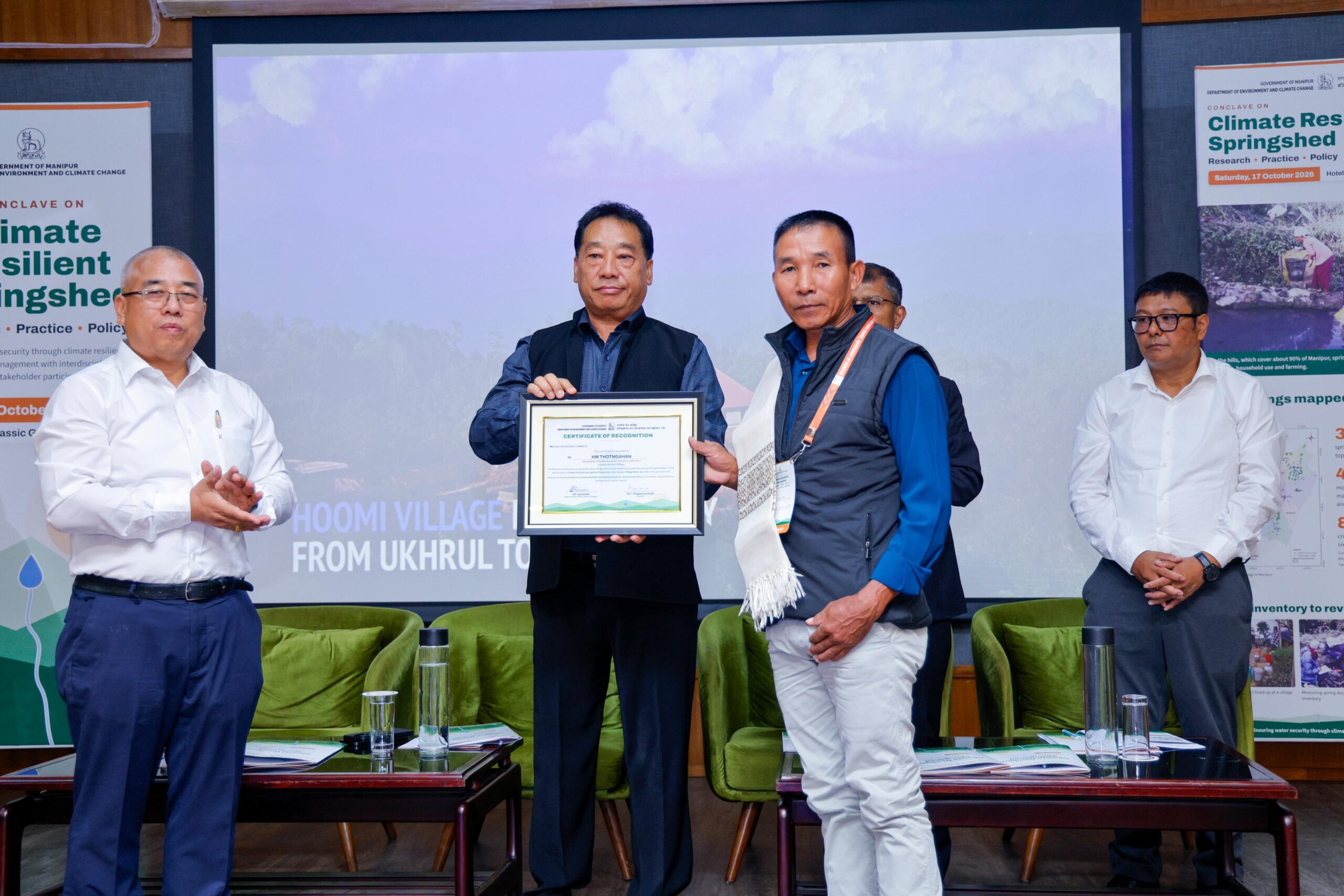
Village authorities of Lunghar and Hoomi (Ukhrul district) and Community Resource Persons (CRPs) were also felicitated on the occasion. A short video on “Climate Resilient Practices for Water Security and e-flow of Rivers” was also showcased during the event.
The programme was followed by Technical sessions with representative from ACWADAM, Pune sharing experience on ‘Key observation and reflection on springshed work in Manipur’; panel discussions on ‘Case studies on Springshed Management (success stories and challenges) with resource persons from Meghalaya, Sikkim, ICIMOD, Kathmandu and Forest Department, Manipur; ‘Research on climate change impacts on springs (needs and ongoing research)’ with resource persons from NIT Manipur, Dhanamanjuri University, Manipur, ACWADM, Pune and Aaranyak, Assam; ‘Practice on springshed management by community involvement (success stories and challenges)’ with resource persons from MIKC, Ukhrul, DHP, Mantripukhri, Imphal, RNBA, Imphal and Environment and Climate Change Department, Manipur and ‘Policy on climate resilient springshed ecosystem in Manipur through participation and convergence of multiple stakeholders-Way Forward’ with resource persons from Forest Department, Manipur, Water Resources Department, Manipur, Public Health Engineering Department, Manipur, Agriculture Department, Manipur, Horticulture Department, Manipur, Environment & Climate Change Department, Manipur and NABARD, Manipur Regional Office.
The conclave was attended by Shri Ph. Vivekananda Sharma, Joint Director, Department of Environment & Climate Change, Manipur; R.K. Dayananda, Joint Secretary, Forest, Environment & Climate Change, Manipur; Pradip Phanjoubam, Veteran Journalist along with officials of the Department, scientists and experts from various states.