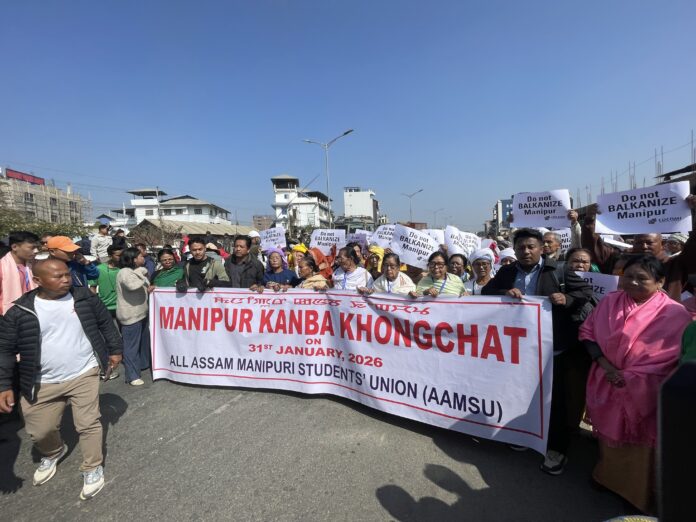

Imphal: In one of the largest public mobilisations witnessed in the state in recent years, the streets of Imphal on Saturday were flooded with people as the Coordination Committee on Manipur’s Integrity (COCOMI) organised a massive rally to draw national attention to the continuing crisis in Manipur and what it described as the “duplicity” of the Indian government in addressing the issue.
More than one lakh people, cutting across age, profession, and social background, participated in the rally, underscoring the depth of public anger and frustration. The procession began at Tiddim Ground near Imphal Airport and culminated at THAU Ground in Thangmeiband, Imphal West, with participants marching in disciplined lines while raising slogans demanding justice, peace, and accountability.
COCOMI leaders alleged that both the State and Central governments had failed to take decisive steps to resolve the nearly three-year-old ethnic conflict between the Meitei and Kuki communities.
Addressing the gathering, the organisation accused the Centre of deliberately allowing the crisis to fester, claiming that “illegal narco-terrorist elements” were being used as proxies to undermine the historical, territorial, and administrative sanctity of Manipur.
The rally also highlighted the continuing humanitarian crisis in the state. Thousands of internally displaced persons (IDPs), uprooted by the violence, continue to live in relief camps under difficult conditions, with little clarity on rehabilitation or resettlement. COCOMI leaders pointed out that despite repeated appeals, these displaced citizens have been denied what they termed their “rightful opportunities” in a democratic country.
Speaking to mediapersons on the sidelines of the rally, Khuraijam Athouba, former Convenor of COCOMI, said that the people of Manipur had repeatedly approached the Government of India with urgent demands, particularly for the resettlement of IDPs and a comprehensive resolution of the crisis. However, he alleged that a “deliberate false narrative” was being promoted to portray the situation as a purely ethnic conflict, thereby absolving the Centre of responsibility.
“The reality is far more complex and grave,” Athouba said. “Reducing this crisis to an ethnic issue ignores the larger security, humanitarian, and governance failures that have pushed Manipur to the brink.”
Following the conclusion of the rally at THAU Ground, a large public convention was held, during which several key resolutions were unanimously adopted. Among the major demands was the immediate abrogation of the Suspension of Operations (SoO) agreement with Kuki armed groups.
The convention also called for the formulation of a concrete and time-bound policy for the rehabilitation and resettlement of IDPs, decisive action to curb cross-border activities of Chin-Kuki narco-terrorist groups, and firm measures to preserve Manipur’s territorial and administrative integrity.
The massive turnout and the resolutions adopted at the convention sent a strong signal of public sentiment in Manipur, as civil society groups continue to press for urgent intervention and a sustainable solution to the prolonged crisis that has deeply scarred the state.