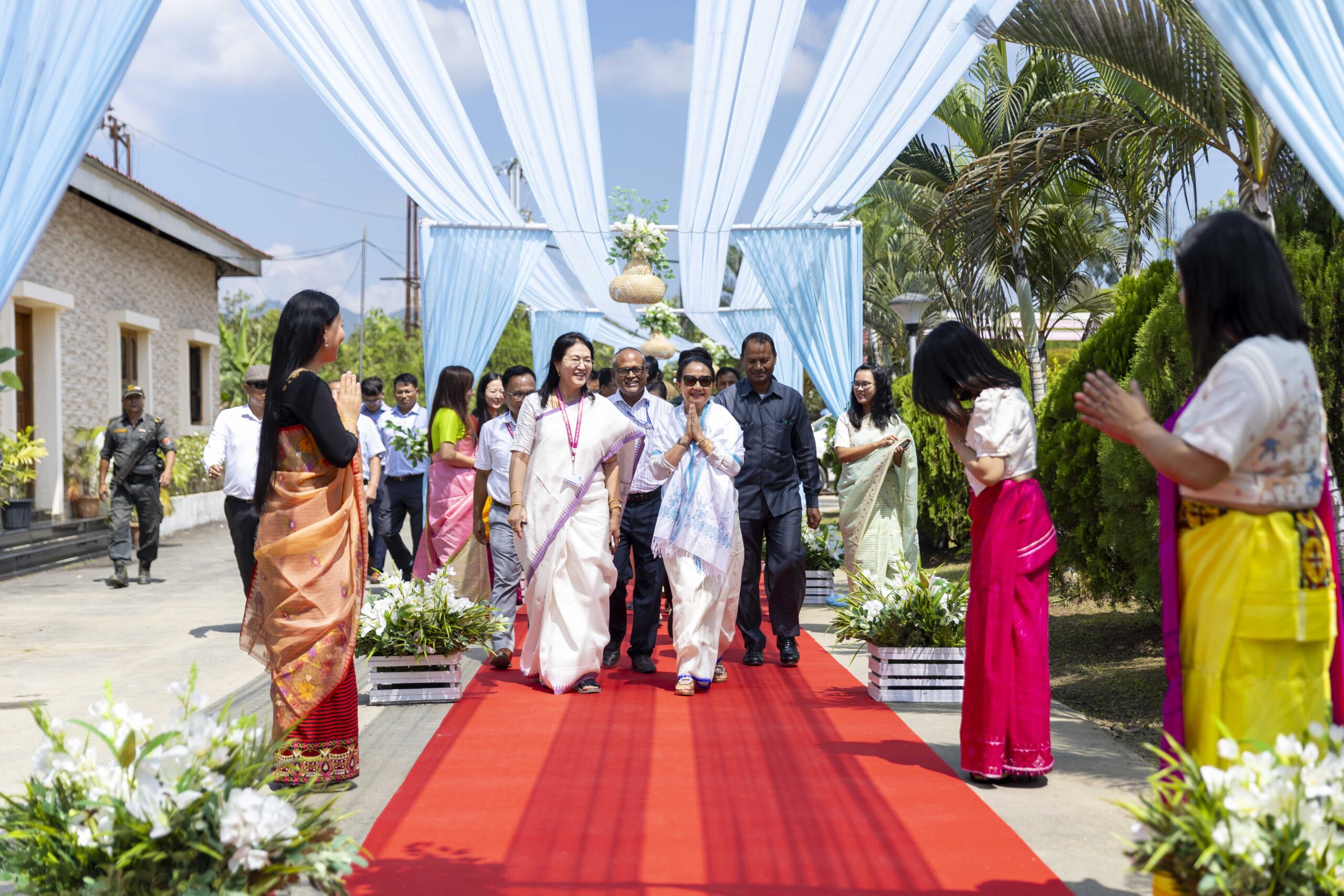

Imphal: The Institute of Bioresources and Sustainable Development (IBSD), Imphal, a constituent institute of the Biotechnology Research and Innovation Council (BRIC), organised a Societal Development Lecture on “Indigenous Knowledge Systems and Viksit Bharat 2047” today at the BRIC-IBSD Campus, Takyel, Imphal west.
The lecture focused on the importance of India’s rich indigenous knowledge traditions and their potential contribution to the vision of Viksit Bharat 2047, with particular emphasis on biodiversity conservation, medicinal plants, agriculture, sustainable resource management and the need to connect traditional wisdom with modern scientific research.
Dr. Joram Aniya, Hon’ble Member, NITI Aayog stressed the need to understand, preserve and carry forward indigenous knowledge systems in a rapidly changing world. She observed that a large section of society continues to remain connected with indigenous ways of life through villages and communities, and said the challenge is to ensure that knowledge accumulated through generations is not lost but made relevant for future generations.
Dr. Aniya stated that indigenous knowledge has a particularly close relationship with nature, with traditional communities observing natural changes to guide agricultural activities. Recalling her own experience, she said her mother and people in her village would observe the blooming of particular flowers, the appearance of fruits and changes in weather to determine the appropriate time for sowing crops. Such practices represented an understanding of natural cycles developed through generations of close interaction with nature.
Traditional communities, she said, not only worked according to nature but also understood the need to minimise damage to the environment. However, with changing lifestyles and increasing dependence on modern systems, several traditional practices are gradually being forgotten. Referring to traditional agricultural resource-management systems, including methods of bringing water from the hills, she questioned whether such systems could be scientifically improved and modernised rather than simply abandoned, Dr. Joram Aniya said.
Sharing the example of Ziro in Arunachal Pradesh, Dr. Joram Aniya highlighted the traditional agricultural system of the Apatani community, where paddy cultivation is integrated with fish farming and crops such as millet or ragi are grown on the bunds separating the fields. The traditional fields, seasonal flowers and surrounding greenery have created a unique landscape in which agriculture, biodiversity and culture exist together.
The traditional agricultural landscape of Ziro has also become an important tourism attraction, particularly with the emergence of the Ziro Music Festival, she said. Modern tourism activities have been developed around the existing agricultural landscape, with visitors staying in tents and experiencing the paddy fields, natural surroundings and seasonal flowers. The example demonstrates how traditional agriculture, fish farming, biodiversity and modern tourism can be brought together without losing the cultural character of the landscape, Dr. Joram Aniya said.
Dr. Joram Aniya particularly highlighted the contribution of Apatani women in maintaining the traditional agricultural system. Considerable physical labour is required to maintain the bunds of the paddy fields, which are essential to the functioning and appearance of the entire system. With younger generations increasingly engaged in education and employment outside the villages, she raised the question of how such systems could be maintained when traditional physical labour becomes less available.
She called upon researchers to look for scientific and technological solutions to sustain these traditional systems. Biotechnology, she suggested, could be explored to reduce soil erosion, conserve soil and water and strengthen the agricultural system while retaining its biodiversity, fish population and natural beauty. “The objective should be to support the traditional system rather than replace it,” Dr. Joram Aniya said.
She also highlighted the role of indigenous practices in maintaining biodiversity, citing traditional community-based systems in which hunting is regulated and undertaken according to need and, in some cases, with community permission. Such practices have helped preserve rich biodiversity, with different varieties of animals, flowers and plants continuing to thrive in such areas, according to Dr. Joram Aniya.
Dr. Joram Aniya stressed that indigenous knowledge should not merely be preserved as folklore but should be examined using modern scientific tools and methods. Scientific research and testing can provide new understanding and evidence, while researchers should also remain conscious of the knowledge and messages passed down by ancestors. The combination of the two, she said, can help develop solutions that are scientifically sound while remaining rooted in local knowledge.
Linking the discussion with the vision of Viksit Bharat 2047, she called upon research scholars, scientists and others associated with scientific institutions to reflect on their responsibility towards preserving indigenous knowledge and biodiversity. She asked what vision scientific institutions should have by 2047 and how research and innovation can help ensure that traditional knowledge systems remain relevant and beneficial to future generations, Dr. Joram Aniya said.
Dr. Nanaocha Sharma, Director (Additional Charge), BRIC-IBSD, highlighted the Institute’s efforts to conserve and sustainably utilise India’s rich bioresources, particularly those of the North-Eastern region. He stressed the need to bridge indigenous knowledge with modern science to promote innovation, sustainable livelihoods and conservation. He also informed that BRIC-IBSD has filed for GI tags for two varieties of black rice from Manipur, and called for greater synergy between traditional wisdom and science towards Viksit Bharat 2047.
The programme was attended by Dr. R.K. Radhesana Devi, Director, Planning Department, Government of Manipur; Dr. R.K. Tombisana Singh, Joint Director, Planning Department, Government of Manipur and other officials of the institute were also present.
The programme also featured the release of the book “A Compendium of Medicinal Plants of the Family Zingiberaceae from North-East India”, which is expected to contribute to greater awareness, documentation and scientific understanding of the medicinal plant wealth of the North-Eastern region.