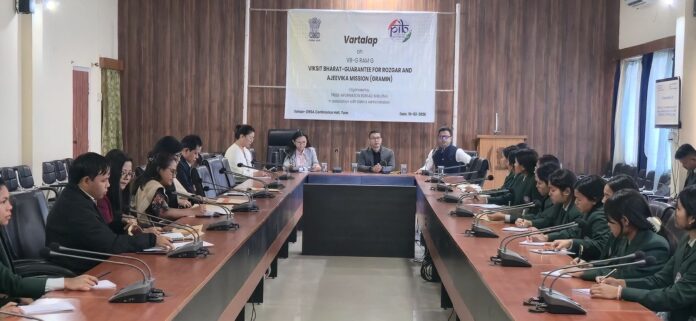

Shillong: Press Information Bureau, Shillong organised a Vartalap programme in Tura, Meghalaya on Viksit Bharat – Guarantee for Rozgar and Ajeevika Mission (Gramin) [VB–GRAM G] with the objective of promoting awareness and encouraging participatory governance at the grassroots level, in alignment with the national vision of Viksit Bharat @2047.
The programme witnessed the participation of key district-level officials, media professionals, students, and other stakeholders. Deliberations focused on participatory planning, convergence of government schemes, livelihood generation (rozgar and ajeevika) and promotion of community-led development in rural areas.
Addressing the gathering, Nippon Hajong, ADC & Project Director, DRDA, elaborated on how the Viksit Bharat – Guarantee for Rozgar and Ajeevika Mission (Gramin) aligns with the broader vision of Viksit Bharat @2047, which aims to transform India into a developed nation by the year 2047. He emphasised that empowered villages form the foundation of this vision and that development must be people-centric, inclusive, and participatory.
Hajong also highlighted the potential benefits of VB–GRAM G, including more guaranteed days of work, timely wage payments, creation of productive rural assets, and the use of digital systems to reduce delays and leakages, thereby ensuring transparency, efficiency, and improved service delivery under rural employment and livelihood initiatives.
He further stated that such outreach programmes help generate awareness among the masses through effective use of media and engagement of various stakeholders. He underlined that informed citizens are essential for participatory governance and that platforms like Vartalap help bridge the information gap between government initiatives and the people, ensuring better outreach and implementation.
Cherime W. R. Sangma, Block Development Officer (BDO), Rongram Block, explained the key features of the Viksit Bharat – Guarantee for Rozgar and Ajeevika Mission (Gramin), highlighting its emphasis on participatory planning, identification of village-specific needs, and effective execution of development initiatives. She stated that Viksit Gram Panchayat Plans (VGPPs) are prepared at the village level through a bottom-up planning framework and are integrated into Block, District, and State-level plans. She added that these plans are aligned with the Viksit Bharat National Infrastructure framework, covering sectors such as water security, core rural infrastructure, livelihood-related infrastructure, and climate change and disaster mitigation.
She also spoke about awareness activities being carried out across the district at the Area Employment Council (AEC) and Village Employment Council (VEC) levels to sensitise communities about government schemes, entitlements, and the importance of active participation in planning and implementation processes.
Michelle C. H. Momin, District Mission Manager, NRLM, MSRLS, dealt with the Ajeevika component of VB–GRAM G, highlighting how livelihood-focused interventions under the National Rural Livelihoods Mission (NRLM) strengthen rural economies, promote self-employment, and ensure sustainable income generation through women-led institutions, Self Help Groups, and community organisations.
Gopajit Das, Assistant Director, PIB Shillong, explained the purpose of the Vartalap programme and stated that the Bureau has been organising such outreach and communication initiatives to spread awareness about flagship government programmes, including VB–GRAM G, and to facilitate informed dialogue between the government, media, and citizens.
The interactive Vartalap session enabled meaningful exchange of ideas, feedback, and best practices related to rural employment, livelihoods, and governance.
The programme was attended by representatives from Doordarshan, All India Radio (AIR), the Directorate of Information and Public Relations (DIPR), private media houses, and students of Master of Social Work (MSW), ICFAI University, Tura.
PIB Shillong continues to organise outreach and communication programmes to disseminate information on flagship government initiatives and to promote informed public participation in the nation’s development journey.