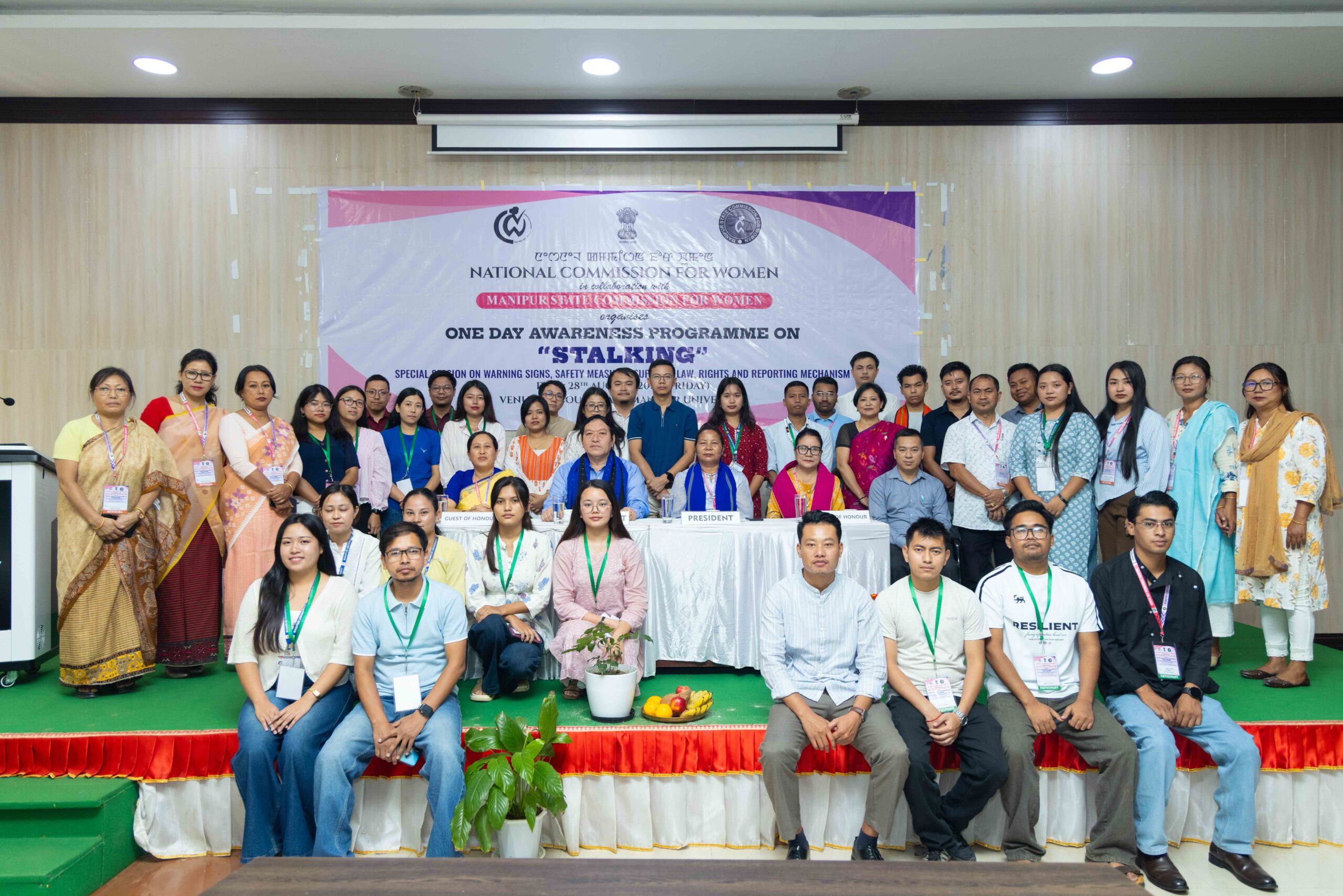

Imphal: Manipur University on Friday held a one-day awareness programme on stalking at the VC Court Hall, bringing together police officials, academics and legal professionals to sensitise students about stalking, including its growing forms in the digital space.
It was organised by the Manipur State Commission for Women (MSCW). The programme focused on helping students recognise stalking, understand its psychological and legal consequences, and know where to seek help when faced with such situations.
Welcoming the participants while delivering the keynote address Member Secretary of the Commission, W. Phajatombi Devi, stressed the need for greater public discussion on stalking and its impact on victims. She said awareness was important as the consequences of stalking often extend beyond the immediate incident and can seriously affect a person’s mental well-being.
Vice Chancellor Prof. R.K. Hemakumar said awareness programmes of this nature provide students with practical knowledge about social problems that cannot always be addressed through classroom learning. He emphasised that understanding how to deal with real-life challenges is an important part of education.
MSCW Chairperson Th.Tiningpham Monsang said the programme was the second initiative of the Commission focusing specifically on stalking. She observed that most of the students attending the programme are adults and can therefore, take the message to their families and communities. She also pointed out that stalking can take place both offline and online and that both forms are covered by law.
Speaking on cyberstalking, Superintendent of Police (Cyber Crime) Shri John Ningombam explained how stalking has increasingly entered people’s everyday digital lives through social media, messaging applications, email, dating platforms and online gaming.
He clarified that a single unwanted message does not necessarily amount to stalking, but repeated unwanted contact despite clear boundaries can become stalking, particularly when it causes fear or distress. He cited fake social media profiles, location tracking, monitoring through friends, leaking private information and unauthorised access to accounts among the common forms of online stalking. He also urged parents to pay attention to their children’s activities on gaming platforms, where similar forms of harassment and unwanted contact may occur.
During the first technical session, Prof. M.C. Arunkumar, Dean, School of Human and Environmental Sciences, Manipur University, highlighted the need for more research on stalking in India. He said there was a need for a broader survey and a standard scale to assess the nature and severity of stalking and its impact on victims.
He noted that the psychological and physical effects of stalking can vary considerably from person to person. Behaviour that may appear to be a minor annoyance to one individual can cause serious distress to another, depending on the person’s circumstances and ability to cope.
Prof. Arunkumar also cautioned against blaming or labelling victims. Repeated unwanted following, monitoring or contact can make victims question themselves, experience self-doubt and confusion, and may gradually develop into fear, anxiety and depression. In more serious cases, prolonged stalking can contribute to post-traumatic stress disorder (PTSD), he said.
He further observed that victims may not always recognise stalking in its early stages, particularly when the behaviour begins with seemingly small or unclear incidents. The resulting fear can gradually build up and interfere with a person’s everyday life.
The second session focused on the practical and legal aspects of dealing with stalking.CO,1st Battalion Manipur Rifles,Khoisnam Sarma, IPS, explained the procedures and avenues available for filing complaints, while advocate Rajkishore Thiyam spoke on the legal rights and protections available to women and measures that can help prevent stalking. Participants were also informed about the cybercrime helpline 1930, which can be used to report cyber financial fraud and seek assistance in cybercrime-related matters.
The programme concluded with an emphasis on early recognition of stalking, providing support to victims without judgement and encouraging those affected to report incidents rather than remain silent.