
Imphal: Stressing the importance of character, commitment, and collective responsibility, Arun Kumar, Sah-Sarkaryawah of the Rashtriya Swayamsevak Sangh (RSS), urged youth to dedicate themselves to national service, declaring, “We must live for the nation every moment.
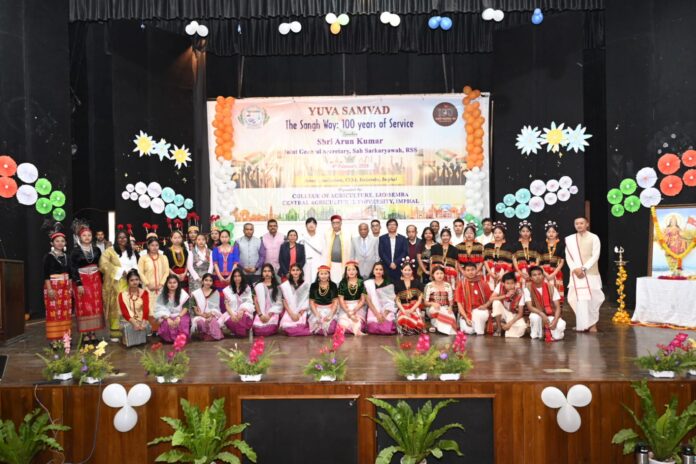
He was addressing a Yuva Samvad (Youth Interaction) programme organized under the theme “The Sangh Way: 100 Years of Service” at the Auditorium of the College of Agriculture, Iroisemba, by the Central Agricultural University (CAU), Imphal.
As Chief Guest and main speaker, Arun Kumar described Bharat as a living civilization, unique in its unbroken cultural continuity and civilizational depth.
He observed that the Constitution of India was framed upon this deeply rooted “collective consciousness,” emerging from thousands of years of India’s civilizational journey.
He emphasized that the RSS vision centers on Vyakti Nirman (individual development) as the foundation of Rashtra Nirman (nation-building).
“Great people make great nations,” he said, adding that political independence alone is not enough to secure the nation’s future without moral strength, discipline, and social responsibility among citizens.
Recalling Dr. Keshav Baliram Hedgewar’s founding vision of the RSS, Arun Kumar said it aimed to unite the people and the nation through individual and social transformation.
“If we are not united, we may again be enslaved, even after independence,” he cautioned.
Outlining the path toward national rejuvenation, he identified five essential aspects of character formation: understanding civilizational identity, putting the nation first, maintaining unity and discipline, staying alert to challenges, and overcoming the lingering effects of colonial thought.
“Losing confidence in one’s heritage weakens society, while rediscovering identity strengthens collective resolve,” he said.
Linking his message to the vision of Viksit Bharat (Developed India), Arun Kumar highlighted the concept of Pancha Parivartan (Five Social Transformations): Samajik Samarasta (social harmony), Kutumb Prabodhan (strengthening family values), Paryavaran Sanrakshan (environmental protection), Swa-Bhav Jagran (awakening of self-awareness rooted in heritage and self-reliance), and Nagrik Kartavya (responsible civic conduct).
He said discipline, respect for law, and civic sense should be viewed as sources of pride rather than compulsion.
Encouraging youth to live a life of purpose, Arun Kumar advocated the principle of “One Life, One Mission,” urging each young person to commit to solving at least one significant social challenge. Unity and coordinated efforts across all sections of society, he emphasized, are essential for preserving national integrity and ensuring progress.
During the interactive session, he discussed unemployment, linking it partly to societal attitudes that undervalue agriculture, skilled trades, and entrepreneurship.
He encouraged youth to develop practical skills, become job creators, and strengthen cooperative movements.Responding to a question on digital distractions, he described student life as a form of sadhana — a period of discipline and self-development — and advised students to focus on physical fitness, mental clarity, and nurturing their natural talents.
The event concluded with an engaging question-and-answer session, reflecting enthusiastic participation from students and faculty and reinforcing the message of youth-led nation-building and social transformation.
The programme was presided over by Prof. Anupam Mishra, Vice-Chancellor of CAU, and attended by faculty members, students, and invited guests.